Beyond Gene Expression: Introducing IsoGraph, a New Framework for Understanding Transcript Choice in the Aging Human Brain
We’re excited to share our new preprint, “IsoGraph resolves coordinated transcript choice and gene abundance in the aging human brain,” now available on bioRxiv!
In this work, we introduce IsoGraph, a computational framework designed to investigate an important but often overlooked dimension of transcriptomic biology: how genes coordinate their choice of RNA transcripts, independently of changes in overall gene expression.
Using human brain transcriptomic data, we demonstrate how IsoGraph can identify coordinated transcript-usage patterns associated with aging, evaluate their reproducibility, and connect these patterns to candidate molecular events relevant to neurological and psychiatric disease.
This is the HEART-GeN Lab’s second preprint. It was first-authored by Alexis Bennett with Elisa Kain Johnson, and Dr. Kynon J. M. Benjamin served as corresponding author.
Looking Beyond How Much a Gene Is Expressed
Traditional gene expression analyses typically focus on measuring changes in the total amount of RNA produced by individual genes. These approaches have transformed our understanding of molecular biology, but they capture only part of the picture.
Many genes produce multiple RNA transcripts, or isoforms, through processes such as alternative splicing and alternative transcript-end usage. These transcripts can differ in their structure and potential biological functions.
Importantly, a gene can change which transcripts it produces without substantially changing its overall expression level.
This distinction raises an important question: can coordinated changes in transcript choice reveal biological signals that conventional gene-level expression analyses miss?
Although existing methods can identify changes in transcript usage within individual genes, detecting coordinated transcript-choice programs across multiple genes, and distinguishing them from changes in total gene abundance, remains challenging. This is the problem IsoGraph was developed to address.
Introducing IsoGraph: Connecting Transcript Choice and Gene Abundance
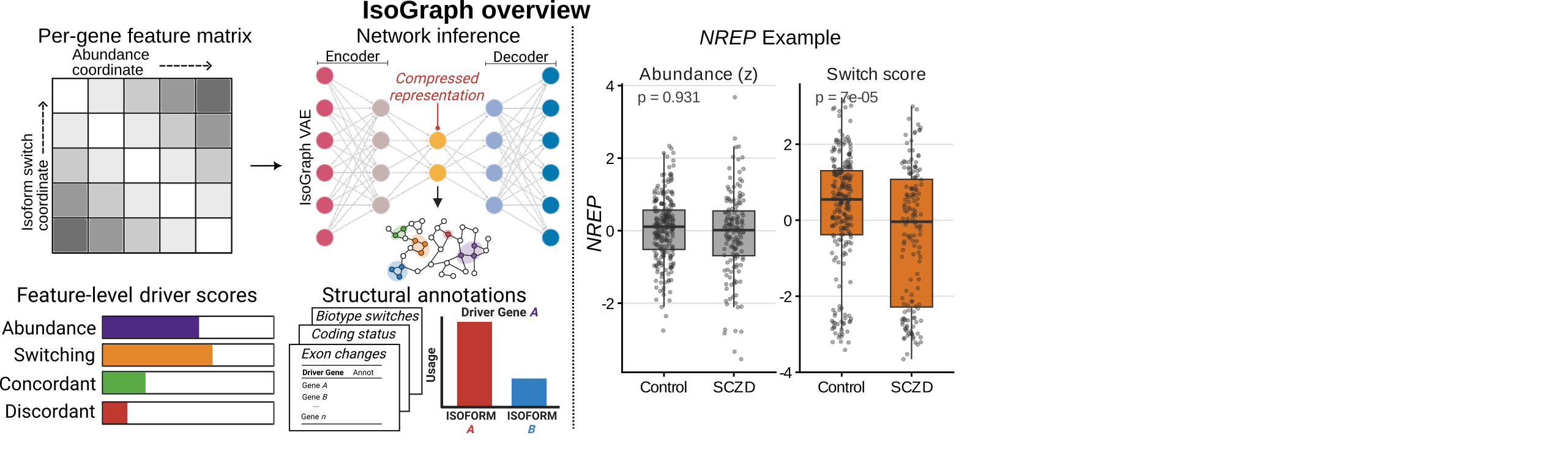
IsoGraph is a gene-centered computational framework that integrates two complementary dimensions of transcriptomic variation:
- Transcript usage: how the relative proportions of different RNA isoforms change within a gene.
- Gene abundance: how the overall expression level of that gene changes.
Rather than treating these signals as interchangeable, IsoGraph represents them as separate but connected channels within a multiplex network. This approach enables researchers to identify groups of genes, or modules, that exhibit coordinated molecular variation and determine whether those patterns are primarily driven by transcript choice, gene abundance, or a combination of both.
IsoGraph also provides tools for network inference, module interpretation, trait association, and the prioritization of transcript-level events. By combining these capabilities, the framework moves beyond identifying isolated transcript changes toward understanding how transcript variation is organized across the transcriptome.
What Did We Discover in the Aging Human Brain?
To evaluate IsoGraph, we combined synthetic benchmarking with analyses of adult human brain transcriptomic datasets from BrainSEQ and the Genotype-Tissue Expression (GTEx) project. Our findings highlight several important insights.
1. Coordinated Transcript Choice Reveals Information Beyond Gene Expression
IsoGraph identified age-associated patterns of transcript usage that persisted even after accounting for total gene abundance. This suggests that studying which RNA isoforms are expressed can reveal additional dimensions of brain aging that are not fully captured by measuring how much RNA a gene produces.
These associations also persisted after adjustment for estimated cellular composition in some analyses, although the results depended on the brain region examined.
2. Transcript-Usage Modules Show Reproducible Biological Signals
We found that IsoGraph modules were stable across subsets of donors. Importantly, module-derived signals retained age associations across cohorts even when the exact genes assigned to individual modules differed.
These findings suggest that coordinated transcript-usage patterns can capture reproducible aspects of transcriptomic organization, despite variability in the precise network structure recovered across datasets.
3. Network Context Helps Identify Transcript-Level Changes
IsoGraph provides information beyond examining each gene independently. In our analyses, module-level context contained predictive information about differential transcript usage in held-out data beyond gene-wise evidence and conventional co-expression approaches.
We also evaluated individual transcript events using several complementary sources of evidence, including transcript structural annotations, short-read splice-junction usage, independent long-read sequencing, and within-donor allelic analyses. Together, these analyses provided additional support for selected transcript-level signals identified through the framework.
4. Connecting Transcript Choice to Disease-Relevant Genetic Signals
Beyond aging, we investigated how IsoGraph findings relate to neurological and psychiatric disease-associated genetic loci. Through genetic colocalization analyses, we prioritized candidate transcript events, including an alternative terminal-exon event involving PRDM2 at a locus associated with amyotrophic lateral sclerosis (ALS).
These findings highlight the potential of integrating coordinated transcript-usage networks with genetic evidence to generate more focused hypotheses about disease-relevant molecular mechanisms. The prioritized events remain candidates for further investigation rather than established causal mechanisms.
Benchmarking and Reproducibility
We also evaluated IsoGraph using synthetic datasets with known underlying signals. These benchmarks demonstrated that the value of transcript-usage and gene-abundance representations depends on the biological signal being studied.
IsoGraph preferentially recovered network structure when coordinated transcript usage was the underlying signal, while abundance-based representations provided advantages in abundance-dominated and RNA-degradation settings. This distinction is important: IsoGraph is designed to examine complementary forms of molecular variation, not to suggest that transcript usage should replace conventional gene expression analysis.
To support transparency and reproducibility, we have made the IsoGraph software and accompanying analysis resources available to the research community.
Why This Matters
Understanding the molecular processes associated with human brain aging requires examining more than whether genes are expressed at higher or lower levels. Our findings suggest that the coordinated selection of RNA isoforms represents an additional, reproducible dimension of transcriptomic organization.
IsoGraph provides a framework for studying this variation in the context of gene abundance, identifying coordinated modules, and following network-level signals back to individual transcript events that can be investigated further. Although our findings establish associations rather than causal relationships, they provide a foundation for investigating how transcript regulation contributes to biological aging and potentially to neurological disease.
We hope IsoGraph will be a useful resource for researchers studying alternative splicing, transcriptomics, systems biology, brain aging, and disease-associated molecular variation.
Explore the Preprint and Software
We’re excited to share IsoGraph with the broader scientific community and welcome feedback, discussion, and opportunities for collaboration.
- Read the preprint: IsoGraph resolves coordinated transcript choice and gene abundance in the aging human brain
- Explore IsoGraph on GitHub: github.com/heart-gen/IsoGraph
- Install the software: IsoGraph on PyPI
- Read the documentation: isograph.readthedocs.io
- Access the benchmarking resources: Zenodo benchmark archive
- Share the preprint: Download the bioRxiv QR code
- More software from the lab: HEART-GeN software page
Preprint authors: Alexis Bennett, Elisa Kain Johnson, and Kynon J. M. Benjamin.
This manuscript is currently available as a bioRxiv preprint and has not yet undergone peer review.
Advancing transcriptomics means understanding not only how much RNA genes produce, but also which transcripts they choose, and how those choices are coordinated across the genome.